

The Minister of Works and Transport, Hon. Fred Byamukama, has challenged the newly inaugurated National Building Review Board to strengthen the regulation of building operations, enforce construction standards and prioritize the protection of human life and property.
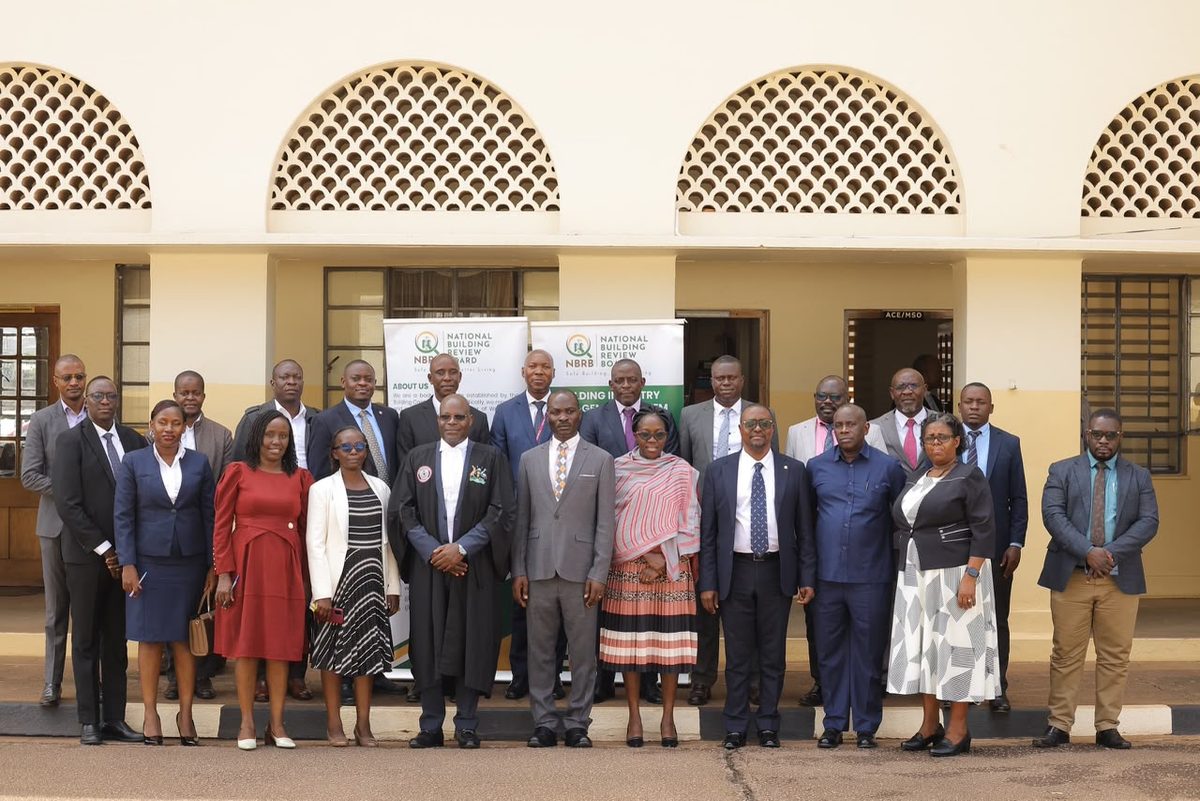
The Minister made the remarks during the inauguration and swearing-in ceremony of the second National Building Review Board, whose nine members took the oath of office. The ceremony was presided over by His Worship John Paul Edoku, while Eng. Andrew M. Kitaka was sworn in as the Board Chairperson.
Hon. Byamukama urged the members to treat their appointments as a serious national responsibility and deliver tangible improvements in building safety across the country. He emphasized that the Board must move beyond investigating building collapses after they occur and instead establish proactive mechanisms to monitor construction activities, enforce compliance and identify structural weaknesses before disasters happen.
“Please regulate the buildings put across in Uganda. Let’s start with Kampala,” the Minister directed.
He expressed concern over recurring building collapses in Kampala and other parts of the country, attributing some of the challenges to weak enforcement, corruption and disregard for approved building plans. He noted that some developers allegedly obtain building approvals through bribery without adequate consideration of soil conditions, structural designs and the competence of contractors.
The Minister stressed that approval of building plans alone is not sufficient unless actual construction works comply with the approved designs and are undertaken by qualified professionals.
He further called for stronger coordination between the Board, Kampala Capital City Authority (KCCA), local governments, Resident District Commissioners (RDCs), Resident City Commissioners (RCCs), local councils and town clerks to improve monitoring and enforcement of building regulations.One of the key assignments given to the new Board is to undertake a comprehensive assessment of buildings in Kampala and other urban centres to establish their capacity to withstand earthquakes of magnitude 6.6 and above.
The Minister referred to an earlier directive by the President to the engineering fraternity, the National Building Review Board and the Ministry of Works and Transport to establish the earthquake resilience of buildings across Uganda.
He cited the 1966 Toro earthquake, which reportedly caused structural cracks in several buildings, including Virika Catholic Church, as an example of the potential risks associated with seismic activity.
He challenged the Board to establish whether existing buildings, particularly high-rise structures in Kampala, meet the required structural safety standards to withstand such seismic events. He emphasized that the assessment should be treated as a preventive intervention to protect lives, property and investments.
In his inaugural address, the new Board Chairperson, Eng. Andrew M. Kitaka, pledged to lead a focused, professional and decisive team committed to promoting a regulated and sustainable built environment.
He observed that buildings are essential to everyday life, providing spaces for homes, schools, healthcare facilities, businesses and public services. However, poor construction practices, disregard for approved designs and the engagement of unqualified personnel can result in loss of lives, property and livelihoods.
“Regulation properly understood is not a roadblock to development. It is the foundation that makes development durable,” he said.
Eng. Kitaka explained that the Board’s mandate is anchored in the Building Control Act, which provides for the regulation of building operations in Uganda.
Its responsibilities include monitoring building developments across the country, overseeing building committees in districts and urban authorities, inspecting their operations, hearing appeals against their decisions and determining fees charged for building plan approvals, building permits and occupation permits.
He emphasized the need for public education on building safety, particularly the importance of obtaining building and occupation permits and engaging qualified professionals.
Presiding over the inauguration, His Worship John Paul Edoku congratulated the Chairperson and members upon taking their oaths of office, reminding them that their commitments must be reflected in their professional conduct and execution of responsibilities.
He urged the Board to discharge its mandate fairly, independently and professionally, without compromising standards or serving personal interests.
“The oath you have taken are not merely words, but to follow them in your work fairly and with professionalism,” he said.
He further cautioned members against undue influence and emphasized that integrity must remain central to their operations, particularly when reviewing decisions and enforcing building standards
“Integrity is very important in executing your duties. Do not allow to be compromised,” he advised.
The inauguration of the second National Building Review Board marks an important step in strengthening Uganda’s institutional framework for regulating building operations.
The Board is expected to work closely with building committees, urban authorities, professional institutions and other government agencies to improve compliance, strengthen inspection and enforcement, and promote responsible construction practices.
Its overarching vision is to achieve a regulated and sustainable built environment, with public safety, professional accountability and protection of investments at the center of its mandate.